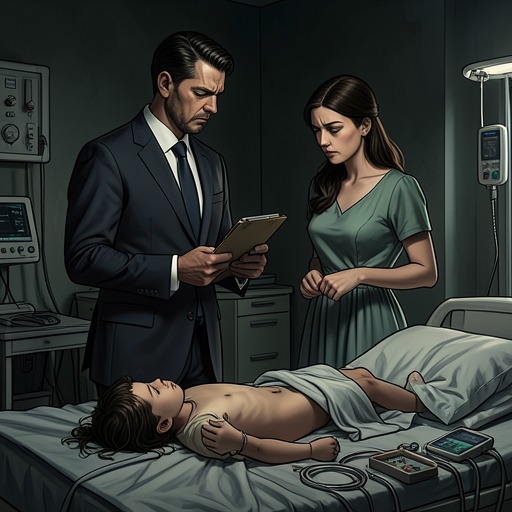
Anna and Elias
Handling the UndeadAnna and Elias’s relationship is the novel’s most intimate test of what it means for a dead child to remain present. Elias’s body has returned, but his mother must learn to distinguish the child she can still address from the memories she once believed were all that remained. Their connection culminates not in recovery or permanent reunion, but in a painful act of care: Anna comforts Elias, holds the small white caterpillar that emerges from him, and lets him go.
Motherhood After Elias’s Death
Elias is Anna’s son, and her understanding of their relationship is shaped first by the ordinary particulars of motherhood. Before his death, he had called to her as a child needing his mother: while she was mowing the lawn, she heard his clear, high-pitched voice in her head saying, “Mummy, come! Grandad is angry. I am going to ...” The unfinished message is one of the occasions on which Elias has actually spoken to her since returning. It carries the familiar urgency of a child seeking her, even though it reaches her inwardly rather than through an ordinary conversation.
Anna’s memory of the grave marks the depth of her earlier grief. She had gone to Råcksta Cemetery, sat or lain by Elias’s grave, and whispered to it. She understood that his body was there, but believed he could not hear her and that nothing of him remained beyond memory. In that account, Elias had become the sum of specific, cherished fragments: swings, nectarines, Legos, smiles, grumpiness, and his request for another goodnight kiss. The list gives shape to a mother’s effort to keep her son present in memory while accepting that the person who made those memories was gone.
A Presence Beyond Words
On the island, Anna lies on sun-warmed rock and brings Elias outside beside her, wrapped in a blanket. She turns toward him and concentrates on his blotchy forehead, addressing him by name. What comes back is not spoken language but a mute affirmation: “I am here.” The exchange makes their closeness bodily and immediate while preserving the difference between presence and ordinary speech. Elias can answer his mother, but not always in words; Anna attends to him without requiring that he communicate in a familiar form.
The limits of that connection become clear when Elias conveys, “I don't want to.” Asked what he does not want, he answers that he does not want to be here. The exchange changes the meaning of Anna’s care. Elias’s return has allowed their relationship to continue, but his presence does not mean that remaining in this state is what he wants. His mother has to hear not only the reassurance that he is there, but also his refusal of being here.
What Anna Learns About Death
Anna’s account of herself changing—standing on her own feet, hanging laundry, and humming songs she would not have sung a week earlier—connects her renewed capacity for daily life to a changed understanding of death. She says she had been wrong to believe that Elias was only the memories left behind when his body died: “Elias was dead. Elias wasn't gone.” The distinction does not erase the death or restore their former life. Instead, it allows her to recognize that her son has a presence and a will beyond the memories by which she had tried to hold him.
This shift is grounded in the physical facts of the novel’s revival crisis. Death had been treated as the cessation of metabolism, yet the possibility that the body could restart that process unsettles the finality of familiar signs of death. For Anna, the consequence is personal rather than theoretical: the child she once addressed at a grave can answer her. But renewed contact also makes a new responsibility possible. She must take Elias’s wishes seriously, even when doing so means losing his bodily presence again.
The Farewell
Near the end, Anna receives David’s story, thanks him, ends the call, and sits for a long time looking at Elias. She pulls him into her lap and rests her forehead against his. This close, quiet posture recalls the intimate physical care of motherhood, while what follows is a decision about how to care for him now. Anna tells Elias what she has learned from David and assures him that he need not be afraid. Elias asks whether she is sure; she confirms that he can stay inside her until it is time. His body then slumps into her, becoming dead weight, as he goes into her.
Their exchange about meeting again soon gives the farewell its particular tenderness: Elias asks whether they will see each other again, and Anna answers yes. As his speech weakens, a white caterpillar breaks free from his chest, while a dark clump reaches toward it with a hook. Anna cups the caterpillar in her hand and holds it for a few seconds before letting it go. The release turns the abstract claim that death is not the end into an action she must perform. Her bond with Elias persists, but it cannot be expressed as keeping his returned body beside her. In the novel’s closing movement, Anna’s motherhood is measured by her willingness to listen, reassure him, and release him.